Recent developments in the digital economy point to a measurable shift in how technological power is organised. Two patterns are particularly visible: the rapid expansion of state investment in sovereign digital infrastructure, and the continued concentration of compute capacity within a small number of firms and locations.
Fiscal Scale and Intensity of Sovereign Investment
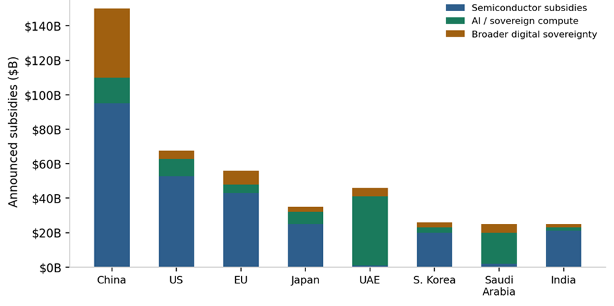
Across eight major economies, governments have announced over $380 billion in subsidies for sovereign digital infrastructure since 2014, with the majority committed after 2020. This scale and timing indicate a shift toward state-led capacity building. China leads in absolute terms, mobilising roughly $95 billion through its National Integrated Circuit Industry Investment Fund, supplemented by an estimated $40 billion in local subsidies. The United States follows with $52.7 billion under the CHIPS and Science Act, alongside loans and tax credits. Japan (~$65 billion), and the EU (~ €43 billion) have launched comparable programmes, while the UAE and Saudi Arabia are investing heavily in AI infrastructure and sovereign compute.